A catch-all domain accepts mail for any address you send to, including ones that were never created. That one setting is the biggest reason email verification sometimes cannot give you a straight answer, and most guides about it stop at "catch-alls are common." We wanted an actual number, so we counted.
For a little over three months, every time our engine checked an address on a business domain, it also asked the receiving server about a second address that could not possibly exist: a long random string at the same domain. A normal server rejects that string. A catch-all server says yes to it. Out of 1,706 business domains that got this test, 662 said yes. That is 38.8%, or roughly two in every five.
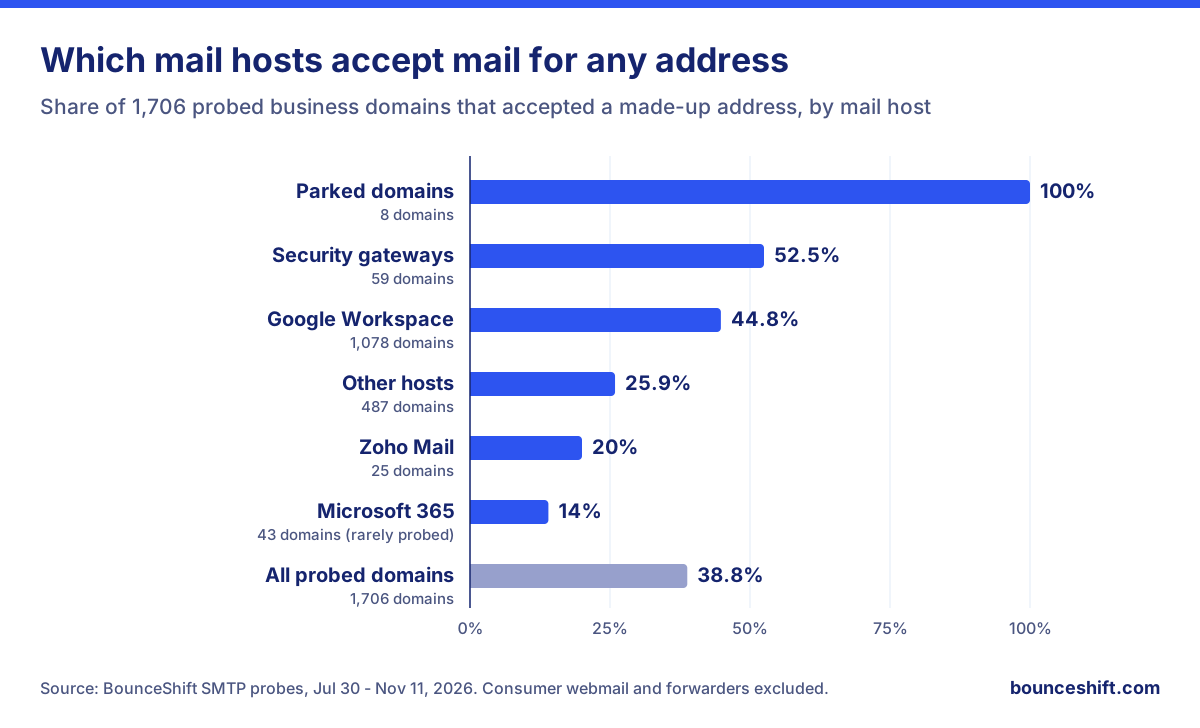
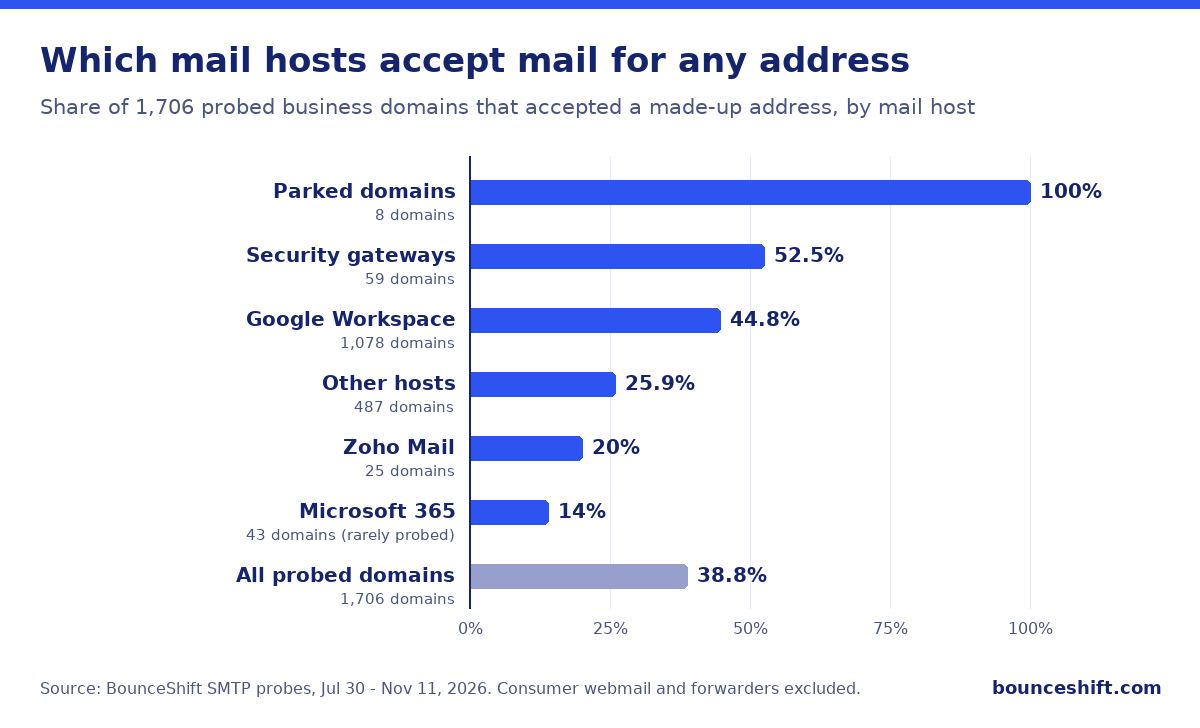
Catch-all rates by mail host
We grouped each domain by the service that handles its mail, which we can tell from its MX records. Consumer webmail (gmail.com, outlook.com, yahoo.com and the rest of our shared-provider list) is left out on purpose: those are not anyone's company domain, and their accept-or-reject behaviour is a different question.
| Mail host | Domains probed | Catch-all | Share |
|---|---|---|---|
| Parked domains (MX at a parking service) | 8 | 8 | 100% |
| Security gateways (Proofpoint, Barracuda, Mimecast and similar) | 59 | 31 | 52.5% |
| Google Workspace | 1,078 | 483 | 44.8% |
| Other hosts (shared hosting, self-hosted servers and so on) | 487 | 126 | 25.9% |
| Zoho Mail | 25 | 5 | 20% |
| Microsoft 365 | 43 | 6 | 14% |
| Host not recorded | 6 | 3 | 50% |
| All probed business domains | 1,706 | 662 | 38.8% |
A further 21 domains used a mail-forwarding service (Cloudflare Email Routing, ImprovMX, Namecheap forwarding, ForwardEmail). We don't probe those at all: a forwarder has no mailboxes of its own, so our engine classifies every forwarding domain as catch-all by rule. They are left out of the numbers above, because counting them would only count our own rule.
The security-gateway number is the interesting one. Proofpoint, Barracuda and Mimecast sit in front of a company's real mail server and filter what comes in. About half the domains behind them accepted our made-up address. Many gateways accept at the door and only check the recipient once the message is inside, which means the gateway answers for the whole company and a verifier never gets to ask the real server.
Workspace rejects unknown users by default, so 44.8% looks high. Admins can turn on catch-all routing in the Workspace console, and plenty do, but most of this figure comes from a single list: 352 of the 483 catch-all Workspace domains came from one list of online-store owners. Leave that list out and the Workspace rate drops to about 21% (131 of 636).
Microsoft 365 needs its own footnote. We rarely send this test to Microsoft 365, because its answers at this stage of the SMTP conversation are not reliable enough to act on, and we check those mailboxes another way. Only 43 Microsoft 365 domains got the random-address test, which is too few to say much.
The average hides a huge spread
The 38.8% figure answers "how common are catch-alls?", but it is close to useless for predicting your own list. Counting only domains that appeared in a single source, the four sources with at least 50 domains each looked nothing alike:
| Source | Domains | Catch-all share |
|---|---|---|
| A list of online-store owners | 644 | 65.4% |
| Work addresses people used to sign up for an online-learning platform | 453 | 36.2% |
| A list of schools | 97 | 17.5% |
| A contact list uploaded through our dashboard | 436 | 5.0% |
Two thirds of the store owners' domains were catch-all, against one in twenty on the uploaded contact list. We can't see why from the data. One likely reason is that a small shop sets its domain up once and points every address at one inbox, while a company with an IT department rejects unknown names. Either way, if your list is mostly small businesses, expect more catch-alls than average.
A catch-all "yes" is not a delivery
We also looked at what happened afterwards. Some of these addresses were later mailed by senders who report their delivery results back to us through ESP webhooks. Of the 464 addresses on catch-all domains that were mailed after we checked them, 16 (3.4%) hard-bounced, even though each server had said yes to everything during the check.
That is lower than on business domains that are not catch-all, where 19 of 243 mailed addresses (7.8%) hard-bounced. That group includes addresses the server had already rejected during our check, so it isn't a fair contest. The point is not that catch-alls bounce more. It is that the server's yes told you nothing: the message is accepted first and the domain decides later whether anyone is there. Sometimes "later" is a bounce, sometimes a shared inbox nobody reads. That is why we report these addresses as catch_all or score them on delivery history, and never mark them valid on the strength of the server's yes. (Only 464 addresses had a later outcome, so treat 3.4% as a rough figure, not a benchmark. Our accuracy write-up reports a lower bounce rate for addresses whose final verdict was catch_all; that is a narrower group, since addresses on catch-all domains can also end up valid, risky or invalid once delivery history is taken into account.)
What to do with this
- Expect a large catch-all segment in any business list, and don't treat it as a sign the verifier is broken. With roughly two in five domains accepting everything, a list of company addresses will often come back with a big
catch_allbucket. - Check what kind of list you have. In our data, the small-business and e-commerce list ran far higher than the others.
- Send to catch-alls as their own segment, at lower volume, and remove anything that bounces straight away. Our guide to handling catch-all emails covers the details.
- Be suspicious of any verifier that returns almost no catch-alls on a business list. The domains did not stop being catch-all; the tool is probably calling them valid.
Methodology and limitations
Data. Every check our validation engine ran between July 30, 2026 (when engine version 16 shipped) and November 11, 2026 where the catch-all test produced a clear answer. We excluded consumer mailbox domains (gmail.com, outlook.com, yahoo.com, icloud.com and about 170 others on our shared-provider list, plus any domain whose MX is Google's or Microsoft's consumer servers) and forwarding services, which are classified by rule rather than probed. That left 1,706 domains and 3,323 addresses.
Test. During the SMTP check the engine asks the server about a random, never-issued address at the same domain. If the server accepts it, the domain is catch-all. Each domain gets one verdict; no domain gave conflicting answers in this period.
Grouping. The mail host comes from the domain's MX records. "Security gateway" means MX at Proofpoint (pphosted.com, ppe-hosted.com), Barracuda, Mimecast and similar filters; "parked" means MX at a domain-parking service.
Outcomes. A later outcome counts only if the ESP reported a hard bounce first seen, or a delivery last seen, after our check.
Limits. These domains come from lists our customers chose to check, not from a random sample of the internet. By top-level domain they lean toward Saudi Arabia (.sa, 250 domains), the Netherlands (.nl, 156) and Brazil (.br, 85). The Google Workspace figure is driven largely by one list, as described above. Microsoft 365 is under-tested. Servers that would not answer at all (timeouts, blocks) are not counted either way.
Privacy. Only aggregate counts are published. We do not publish the domains or addresses involved.