Most lists of "common email problems" are about deliverability: spam folders, blocklists, authentication. This one is about something earlier and more boring. Before any of that can go wrong, someone has to type their address into a form, and a surprising number of them get it wrong.
We looked at 80,122 unique addresses that people entered into one online-learning platform's signup form over a little more than three months, each checked by our API at the moment it was submitted. For 3,711 of them, 4.63%, mail would never have reached the person who typed the address. That is about one signup in 22. Here is what was wrong with them.
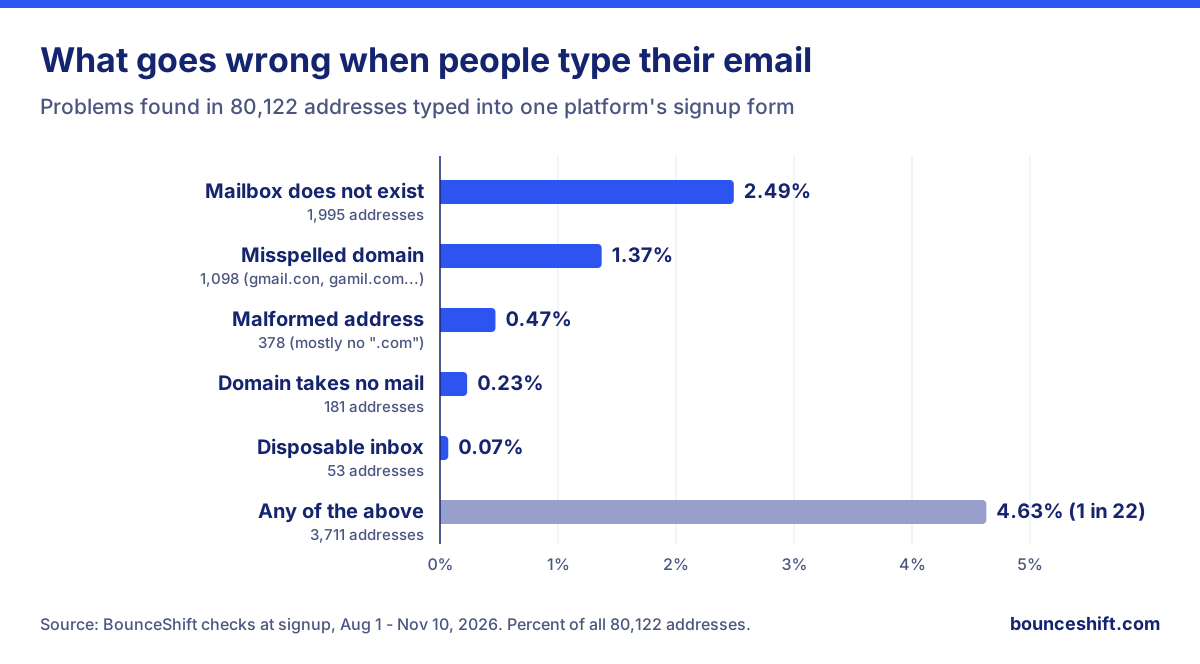
The list of problems, most common first
Each address is counted once, under the first problem we found, so the rows add up.
| Problem | Addresses | Share of all signups |
|---|---|---|
| The mailbox does not exist | 1,995 | 2.49% |
| Misspelled provider domain (gmail.con, gamil.com) | 1,098 | 1.37% |
| Malformed address | 378 | 0.47% |
| The domain cannot receive mail | 181 | 0.23% |
| Disposable inbox service | 53 | 0.07% |
| Do-not-mail (lookalike domain, forwarder, known complainer) | 6 | 0.01% |
| Any of the above | 3,711 | 4.63% |
1. The mailbox does not exist (2.49%)
The domain is fine, the address looks fine, and the mail server says there is nobody by that name. This was the largest group by a wide margin. We can't see why any one address fails, only that it does, but the likely causes are a slip in the part before the @ (a missing letter, two digits swapped) or someone inventing a plausible address because they would rather not give a real one.
Gmail is the cleanest place to measure this, because it accounts for most of the sample and it answers our mailbox checks for nearly every address. Of the 57,690 gmail.com addresses, 1,681 (2.91%) did not exist. That is about one Gmail signup in 34.
2. A misspelled provider domain (1.37%)
The second most common mistake is in the domain: gmail.con, gmail.co, gamil.com, hotmail.con, icoud.com. gmail.con alone appeared 232 times, more than any other misspelling. We found misspellings aimed at Gmail far more than any other provider, but per user iCloud was worse: about 1 in 25 people aiming for icloud.com got the domain wrong, against 1 in 48 for hotmail.com and 1 in 59 for gmail.com.
| Provider | Typed correctly | Misspelled | Roughly |
|---|---|---|---|
| gmail.com | 57,690 | 988 | 1 in 59 |
| hotmail.com | 9,289 | 199 | 1 in 48 |
| icloud.com | 4,920 | 201 | 1 in 25 |
(The misspelled column includes the "no .com" cases from the next section, such as an address ending @gmail.) We break the Gmail misspellings down one by one, including which of them silently accept mail, in our Gmail typo study.
3. A malformed address (0.47%)
We expected this bucket to be full of spaces, double @ signs and commas. It wasn't. Of 378 malformed addresses, 376 had a domain with no dot in it at all, usually because the person stopped typing before the ".com". The most common was plain @gmail (153), then @gmailcom (38), @hotmail (20) and @icloud (18). One had a space and one a non-ASCII character. This is the easiest problem on the page to fix, because a form can spot it before the person even presses submit.
4. The domain cannot receive mail (0.23%)
The domain either does not exist or publishes no way to deliver mail to it: no MX record, or a "null MX" that explicitly refuses all mail. These are usually company or school domains typed slightly wrong, or old domains that have lapsed.
5. Disposable inboxes (0.07%)
Throwaway inbox services get a lot of attention, but genuine ones like Mailinator turned up only 53 times in 80,122 signups. Another 198 addresses were flagged as disposable, but they were on typo domains such as gamil.com and gmil.com, which disposable-domain lists include because mail sent there goes nowhere useful. We counted those as misspellings, since that is what they were. If you have been worrying about disposable addresses at signup, typos are a much bigger problem.
What we could not resolve
4.63% counts only the problems we could identify, so the real share is higher. Another 12,191 addresses (15.2%) came back unknown, meaning we could not prove them good or bad. About four in five of those are on Microsoft consumer domains (hotmail.com, outlook.com, live.com) and iCloud, whose servers accept or block mailbox checks wholesale and give no per-address answer. The rest are spread across Yahoo, Gmail and everything else. Some of those addresses are dead too; we just cannot say which. A further 429 addresses had a full mailbox, which proves the mailbox exists but means mail to it will bounce until the owner clears it.
Role addresses (info@, support@) barely appeared: 71 in total. People do not sign up for things with a shared inbox very often, which makes them a list-cleaning issue more than a signup one.
What to do about it
- Check the address while the person is still on the form. A typo or a dead mailbox caught at signup is fixed on the spot; caught after a bounce, the person is gone.
- Suggest corrections, don't apply them. A "did you mean gmail.com?" prompt handles the 1.37% of misspelled domains. BounceShift returns that suggestion in a
did_you_meanfield, and our free typo finder runs the same check on a pasted list. - Block the obvious ones in the browser. An address whose domain has no dot can be rejected before it is ever sent anywhere.
- Expect some unknowns and handle them separately. Do not drop an iCloud or Hotmail signup because a verifier could not confirm it; confirm it with a welcome email instead.
If you are dealing with a list that already has these problems in it, how to clean an email list covers the cleanup, and how to reduce your bounce rate covers keeping it clean.
Methodology and limitations
Data. Addresses submitted to the BounceShift API from signup forms between August 1 and November 10, 2026, by one high-volume integration: an online-learning platform whose users are mostly in the Gulf region. Each unique address counts once, using its most recent check. 80,122 addresses on 1,458 domains.
Categories. Each address is placed in the first matching bucket: malformed (fails the syntax check), misspelled provider domain (one or two edits from a major provider and rejected or flagged; some of these domains, like gmil.com, accept mail, but it never reaches the person), domain cannot receive mail (no MX or null MX), mailbox does not exist (1,957 rejected by the provider's mail server or account check, 33 with two or more recent hard bounces in our reputation data, and 5 that our catch-all scoring judged likely invalid), disposable service, do-not-mail. Misspelling rates per provider compare suggestion-flagged addresses with correctly typed ones; a few suggestions (for example on email.com, which is a real provider) are wrong, so read those as approximate.
Limits. One platform's audience is not the whole internet. Gmail is 72% of this sample, and the Gulf skew shows up in domains like outlook.sa. Unresolved addresses are left out of the 4.63%, so the real share is higher.
Privacy. Only aggregate counts and public provider domains are published. No addresses, names or customer domains are shown.